Facilitator Spotlight: Rebeca Chavez
posted on: March 5, 2026
category: Community Spotlight
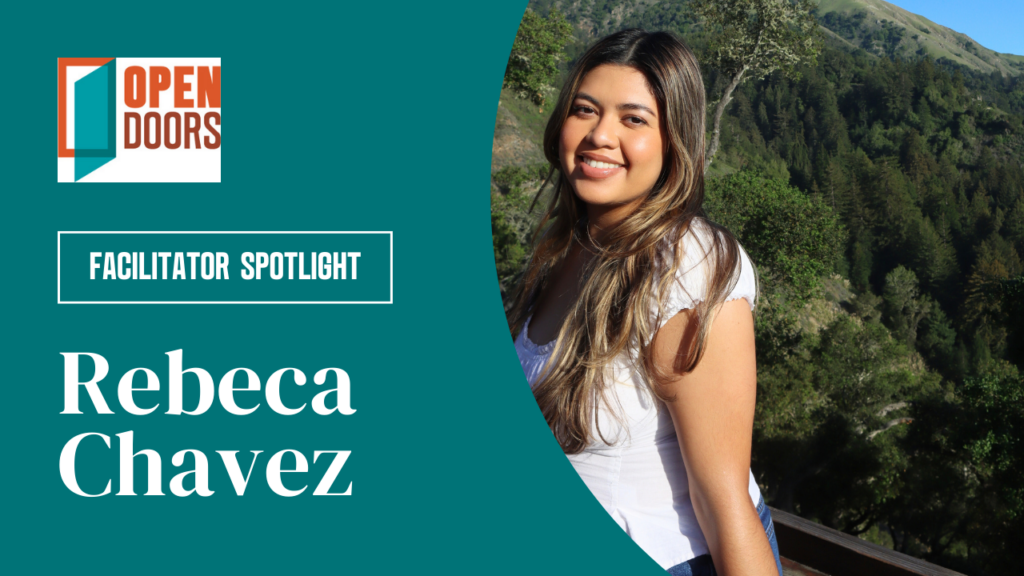
Rebeca Chavez (she/her) didn’t always see herself as a facilitator — but looking back, it’s hard to imagine her as anything else.
From leading literacy circles for teen moms during college to facilitating restorative justice conversations with youth who have experienced prior or current detention, Rebeca has spent her career doing exactly what Open Doors asks of the adults it trains: showing up fully, meeting people where they are, and creating space for real conversation.
In January 2026, she joined Community Solutions as a Workforce Development Facilitator. Community Solutions is a California-based training and workforce development organization that provides professional development for educators, clinicians, and community-based professionals. Their offerings range from substance use disorder overviews and motivational interviewing to clinical certifications like CBT and DBT, mandated reporter training in English and Spanish, and wellness-focused courses.
Among those trainings is Open Doors.
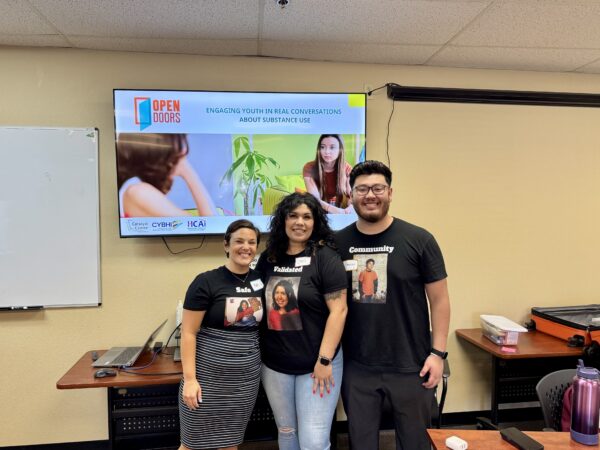
Open Doors is a training program that equips youth-serving adults with tools to engage young people around substance use and other behavioral health concerns in an informed, non-judgmental, relational way. After the Open Doors team facilitated a Core Training for Community Solutions staff, the partnership expanded. This allowed facilitators like Rebeca to bring the training to school districts and community organizations in California’s Central Coast and Bay Area.
Within her first two weeks on the job, Rebeca attended the Core Training in Whittier. Since then, she has facilitated four trainings.
“I never saw myself as a facilitator,” she says with a laugh. “But then I found Community Solutions, saw they were hiring for one, and thought — wait. I’ve been doing this the whole time.”
A Foundation in Education
Rebeca’s roots are in education. She taught preschool and art, facilitated literacy circles for teens who are parenting, and led Restorative Justice conversations with youth navigating the justice system — integrating global Indigenous knowledge and wisdom into the work.
Those experiences shape how she shows up in every training space.
“If a question pops up while I’m talking, I want to hear it,” she says. “I can pause. I’m here for you.”
She also brings intentional lightness. “I try not to take myself too seriously,” she says. “A little silliness helps people relax.”
For Rebeca, that isn’t about performance; it’s about safety. When a room feels human, people are more willing to be vulnerable.
Rooted in Community
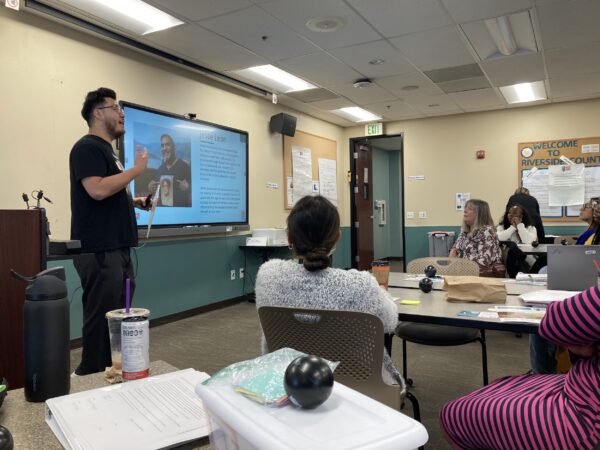
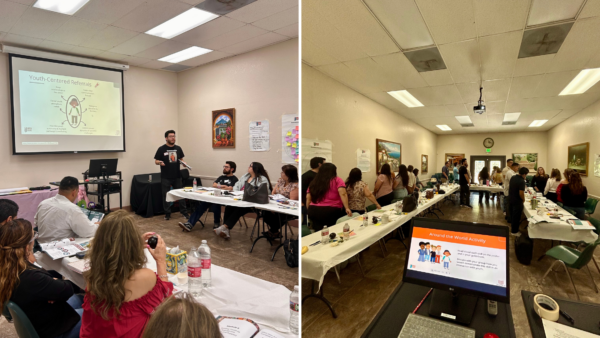
Recently, on February 18th, 2026, Rebeca facilitated an Open Doors Core Training with community liaisons from San Lorenzo Unified School District.
For Rebeca, who grew up in Redwood City, the training felt personal.
“Since I’m originally from the Bay Area, it felt like coming back home,” she says. “Sharing that made it feel like, ‘Oh, it’s one of our own.’”
Bay Area communities, she explains, don’t extend trust automatically — and for good reason. The region holds a long history of systemic inequities alongside powerful movements for justice. That context shapes how people enter a training space.
“There’s kind of an initiation period,” she says. “Are we going to trust you, or are you part of the systems we’re fighting back against?”
Trust was built throughout the day, particularly during a conversation about restorative justice. Rebeca shared an experience from her own schooling, where they claimed to practice restorative justice but still relied heavily on suspension.
A participant echoed her concern, naming how restorative practices can become performative.
“Just hearing my experience be validated by another member of an educative community felt like a full circle moment,” Rebeca says. “This was my experience growing up. And now I’m facilitating conversations about how to do it authentically.”
Even smaller moments reinforced that connection. During lunch, a participant shared a Whitney Houston song she’d listened to on the drive in — one about having an open door.
“She didn’t have to share that,” Rebeca says. “But she made the connection herself. That shows how the training builds community.”
By the end of the day, participants reported that the training felt different from other training sessions they had attended.
For Rebeca, that mattered.
Finding Hope
After years in public education, where systemic barriers can make even dedicated educators feel defeated, Rebeca admits her sense of hope had wavered.
“Being a facilitator has helped me regain that hope,” she says. “Seeing how many people show up. Seeing perspectives shift in one day. That reminds me that people genuinely care.”
For her, facilitation is proof that change is possible and that community members are ready for it.