Beyond “Train-the-Trainer”: Why Facilitation Skills Matter
posted on: November 10, 2026
category: Microlearning
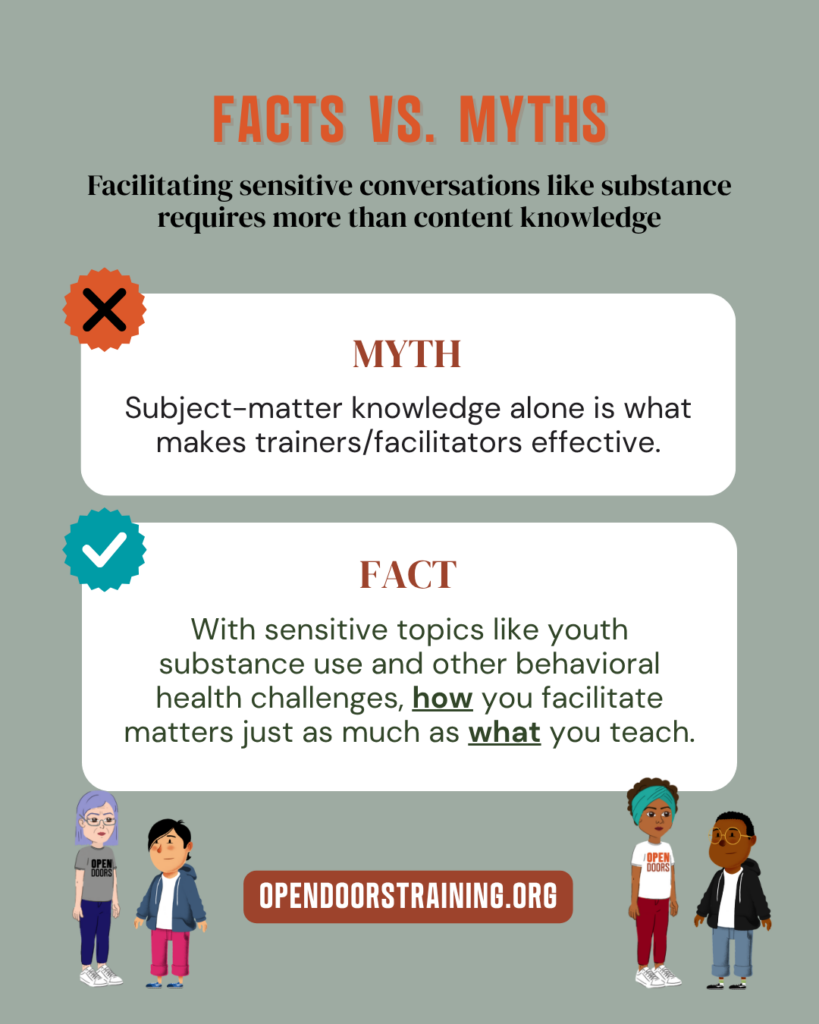
Knowing the material is important. But when you’re facilitating conversations about youth substance use and behavioral health, knowing what to say is only part of the job. How we hold those conversations matters, too.
That distinction is especially important in Open Doors, where relationships are at the center of how we approach conversations with young people… and how we prepare adults to have them.
Curriculum Expertise is Only One Part of Our Facilitator Training
Open Doors’ Core Training curriculum is rooted in harm reduction, cultural humility, restorative practices, youth autonomy, and relationship-centered engagement.
Those aren’t simply concepts for facilitators to explain. They also influence how a facilitator listens, responds, navigates challenging moments, and makes room for different perspectives and lived experiences.
That matters when discussing topics like substance use. What could be an opportunity for an open conversation can quickly become a closed door when people feel judged, uncomfortable, or unable to explore an idea honestly. The same principle applies in a training space: participants need room to ask questions, wrestle with new ideas, and try different ways of thinking.
As Open Doors Facilitator Crystal Blanton explains:
“The content is a guide, but people need to be able to see what these principles look like authentically in practice. That’s what the facilitator brings to the space.”
A Framework, Not a Script
Open Doors isn’t designed to give youth-serving adults a rigid set of steps to follow in every situation.
Young people come from different cultures, communities, families, and lived experiences. So do the adults who support them. A conversation that works with one young person may look very different with another.
Crystal describes Open Doors as “a framework with space for that nuance.” Participants are encouraged to understand the principles, connect them to their professional and lived experiences, and consider how to apply them to the young people and communities they serve.
Facilitators have to be prepared for that same complexity in the training room.
Questions may come up that aren’t answered word-for-word on a slide. Participants may bring different perspectives or experiences into a conversation. A discussion may need more space than expected.
Strong facilitation means staying present and connected to the people in the room—not simply memorizing what comes next in the curriculum.
Going Beyond Traditional “Train-the-Trainer” Programs
That’s also one way Open Doors Community Facilitator Training (CFT) differs from many traditional Train-the-Trainer models.
Train-the-Trainer programs often focus heavily on preparing participants to deliver specific content: reviewing curriculum, becoming familiar with activities, and learning how the training is structured.
Those things are important in Open Doors, too. But they’re only part of the preparation.
CFT also focuses on developing the person behind the curriculum.
Participants practice responding to the room, navigating challenging moments, supporting learners with different experiences and perspectives, and building the confidence to facilitate authentically rather than focusing too much on exactly what they are supposed to say on a particular slide.
As Crystal put it, “CFT focuses not only on curriculum knowledge, but on helping facilitators develop the confidence to show up authentically while talking about these topics and supporting others through them.”
Modeling the Open Doors Approach
In many ways, the facilitation itself becomes part of the learning experience.
- If we’re asking participants to approach young people with curiosity rather than judgment, facilitators should model curiosity.
- If we’re teaching cultural humility, facilitators should make space for perspectives and experiences different from their own.
- If we’re talking about restorative practices and the importance of relationships, the training environment should reflect those values too.
That’s why facilitation skills matter so much in Open Doors. The goal isn’t simply for participants to remember information. It’s to help them consider new ways of thinking, connecting, and responding when young people come to them with complex questions or experiences around substance use and behavioral health.
And sometimes, even one small shift in how someone approaches those conversations can open a door.
Interested in becoming an Open Doors facilitator? Learn more about our Community Facilitator Training.